Personal project
Fitroom
github.com →Overview
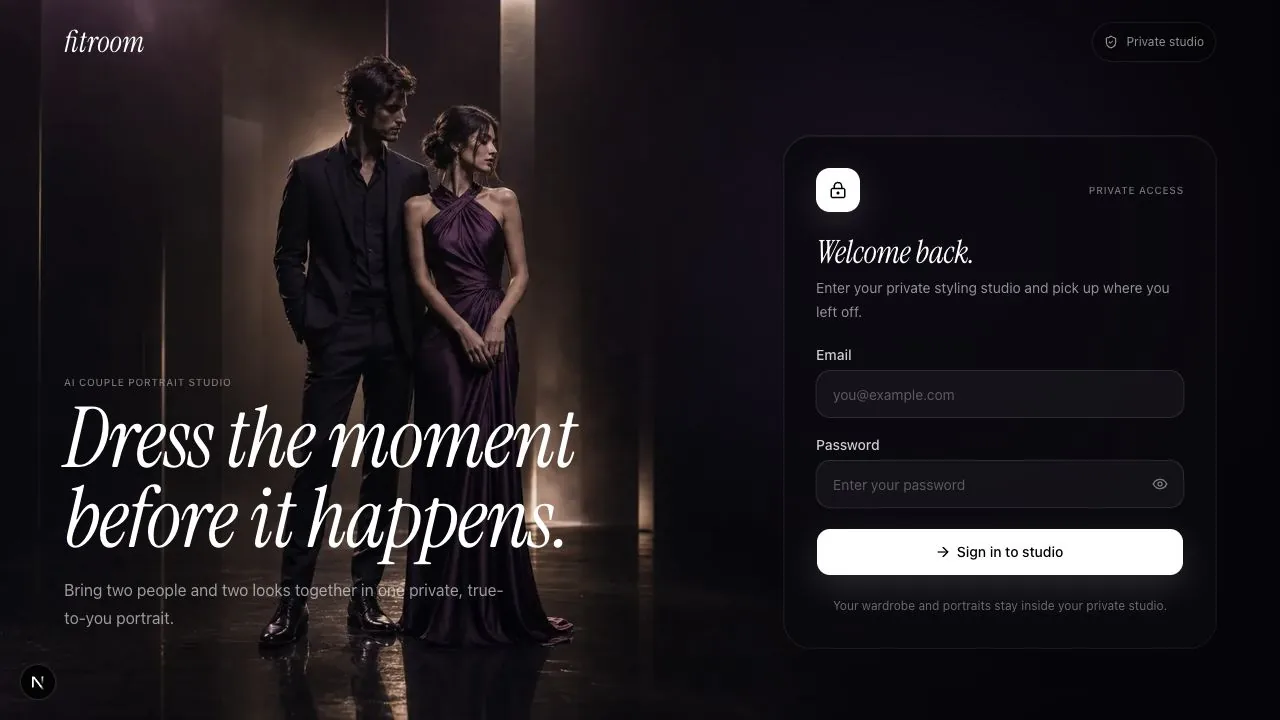
Virtual try-on tools are built for one person at a time, and they quietly lie: faces drift, bodies get idealized, and everyone comes out model-height. Fitroom starts from a different premise — that trying on outfits is something couples do together — and treats fidelity to the two real people as the entire product.
How the idea started. I wanted to compare outfits with my partner, but every try-on product I found treated us as two unrelated solo sessions. Even when the clothes looked plausible, the people stopped looking like us: heights converged, physiques were idealized, and details from the clothing model leaked into the result. Fitroom began as a very specific fix for that gap — put both of us, both outfits, and our real proportions into one shared image.
Why it is personal software. This is not a fashion marketplace or a generic avatar service. It is a private wardrobe built around people I know, clothes we are actually considering, and the small facts that make the output believable to us. I use it as a visual decision tool: save our references once, try combinations together, and keep the renders worth returning to. The model picker, persistent library, and protected deployment exist because I pay the generation cost and use the product myself.
One pass, four references. Both people and both outfits go into a single image-edit call, so the model works directly from the original photos instead of a lossy intermediate. That is what lets faces, skin, and body builds survive the generation. Physique preservation is asserted forcefully in the prompt: the render must show these two people, not the fashion-average bodies image models default to.
Height is data, not vibes. Every saved person carries their real height, and the composite is scaled from it — a 6’0” partner and a 5’0” partner read correctly, side by side, the way they do in photographs. It is a small detail that decides whether the output feels like them or like stock imagery.
The wardrobe is persistent and clean. People and outfits are saved server-side and reused across sessions, and every outfit is pre-processed down to the garment alone. That isolation step means a prominent model in a product photo can never leak their face or build into your couple’s portrait.
The plumbing respects reality. Generation and isolation run as polled background jobs rather than long-lived requests, so nothing trips serverless timeouts, and orphaned jobs are swept up on restart. A model picker switches per render between OpenAI’s gpt-image models and Google’s Nano Banana family, every render is stored with its prompt and model, and the composer keeps the ritual quick: ⌘Enter to generate, draft or high-quality, cancel in flight, download as PNG.
Key Achievements
- Couple composer — Pairs a person and an outfit for each partner and renders both in one photorealistic side-by-side portrait
- True relative height — Uses each person's saved height to scale partners correctly, so a 6'0" and a 5'0" partner read the way they do in life
- Garment isolation — Pre-processes every outfit down to the garment alone, so an outfit model's face or physique can never leak into a render
- Model picker with job queue — Switches per render between OpenAI and Gemini image models, with generation running as polled background jobs
Technologies
Outcome
Fitroom turns virtual try-on into a shared ritual: compose a couple, pick the outfits, and get one portrait that respects who they actually are.